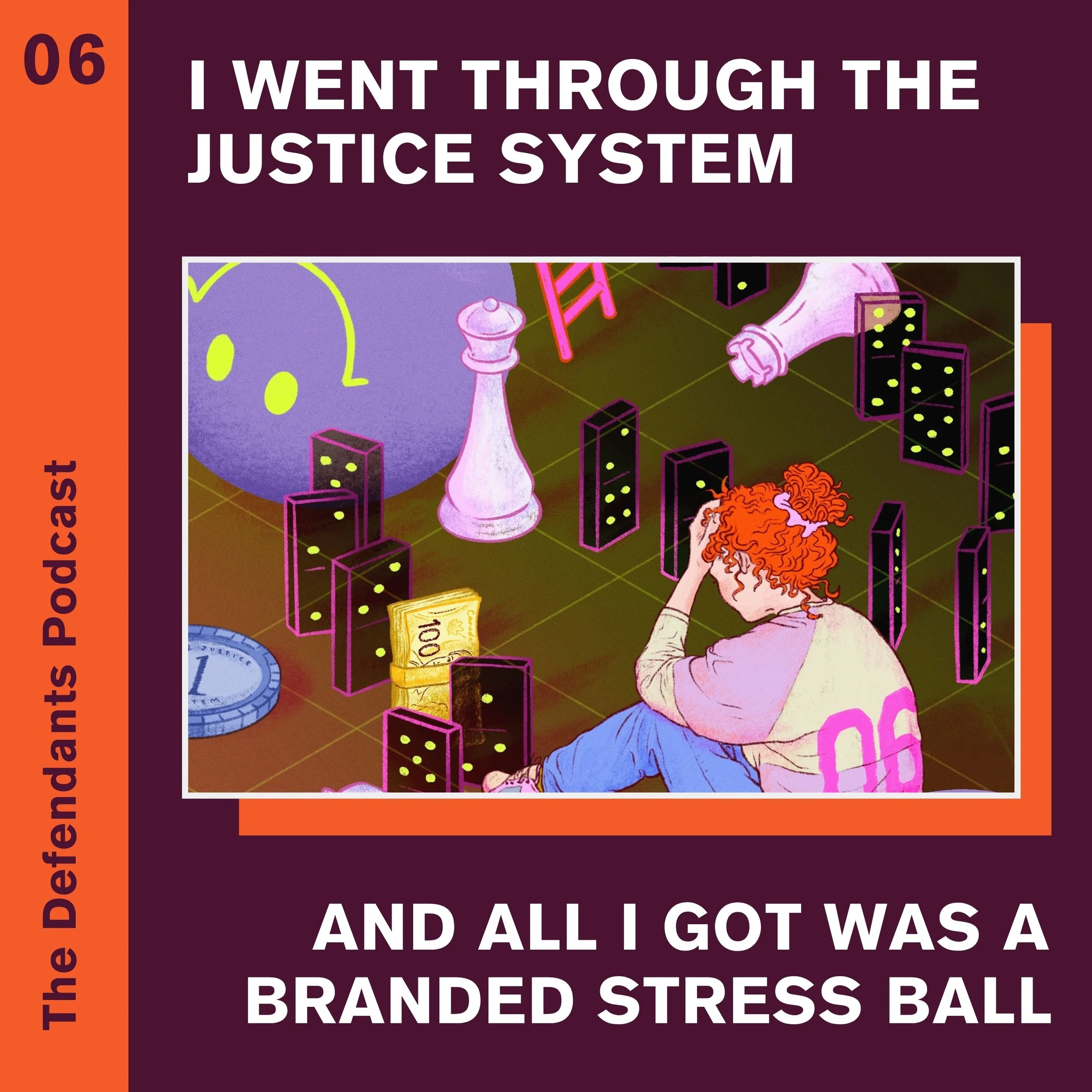
Episode 6: I Went Through The Justice System And All I Got Was A Branded Stress Ball
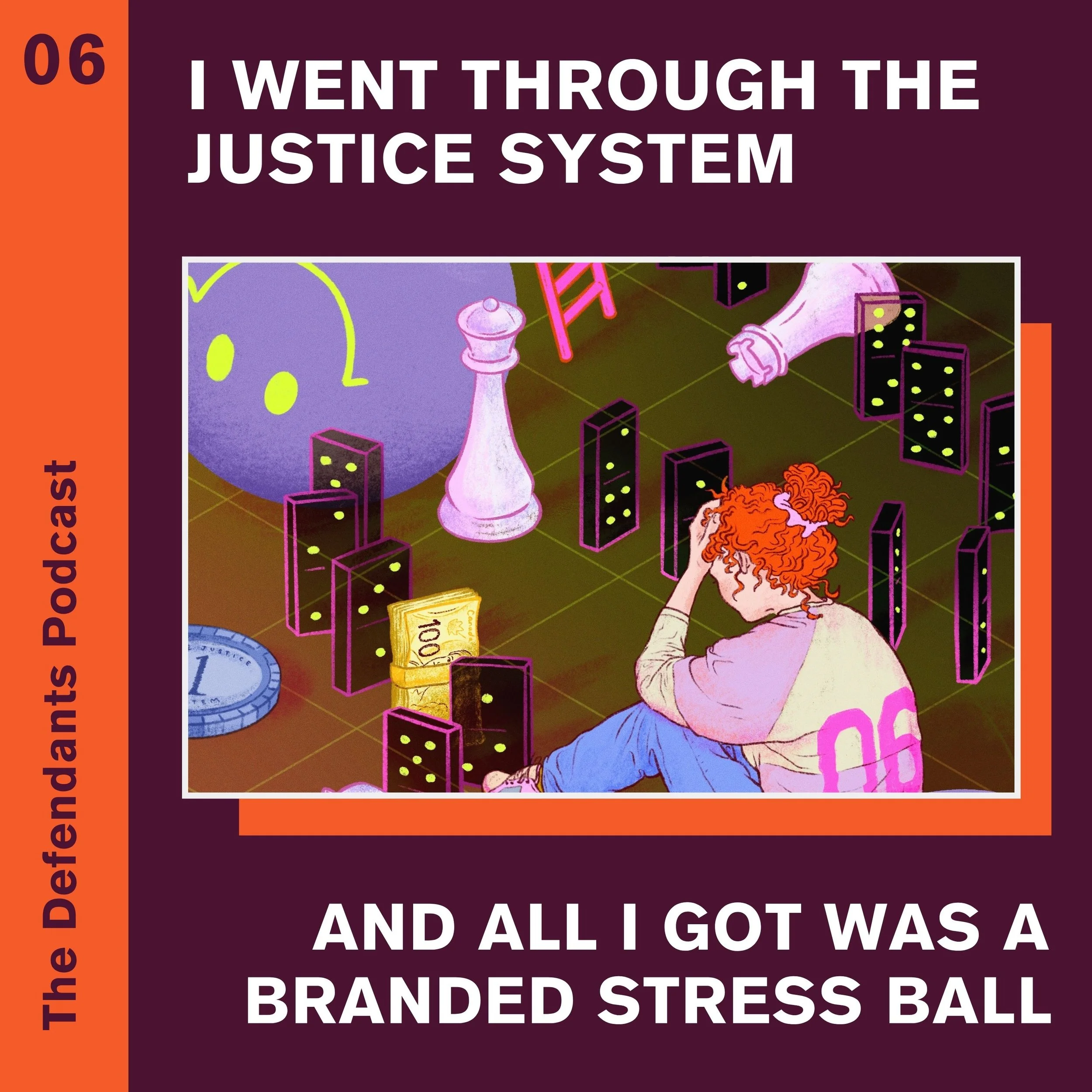
We’re talking about what survivors actually get out of the justice system and what they want out of it.
It’s time to do better than this.

What Do Survivors Actually Want?
Accountability and punishment are not the same thing. Survivors want the former. The system is built to deliver the latter.
But what if we stopped trying to patch a broken system and instead, built a new one designed around what survivors actually need?
A separate system with a lower burden of proof, community-centered consequences, and victim agency at its core?
Key Moments
0:13 - Jane's trial
1:47 - Chanel Miller: guilty verdict, insufficient sentence
4:14 - What survivors want: accountability
5:36 - Denial as a second victimization
6:22 - Restorative justice
8:22 - Surrogates for when direct dialogue isn't safe or possible
11:51 - Civil litigation
13:51 - Contingency fees and the cost barrier
15:01 - NDAs and victim silence
17:22 - A new system: accountability over punishment
Key Topics
Featured Guests
Cheryl Miller, survivor, restorative justice advocate, and author of Enough Silence: Creating Sacred Space for Survivors of Sexual Assault through Restorative Justice
All sources, statistics, multimedia clips, and music credits are available on Substack.
Takeaways
• Denial can feel like a second crime in itself
• Restorative justice results in higher victim satisfaction than the traditional court system
• Civil litigation requires an easier burden of proof (50% and a feather vs 99%) and can reward monetary damages, but victims may be silenced with NDAs
• The current system was built on case precedent, making piecemeal reform nearly impossible
Questions Explored
• What happens when a perpetrator won't participate in the restorative justice process?
• Why do survivors prefer restorative justice even when they don't get a guilty verdict?
• How does civil litigation differ from criminal court, and what are its limitations?
• What are non-disclosure agreements and how do they harm survivors?
Transcript
Disclaimer: This podcast explores sexual violence and the court process surrounding it. Please listen with this in mind, and be kind to yourself. We have resources in the show notes.
Jane Aster Roe: I was called to the stand to testify four years after I was first sexually assaulted.
I coped by plunging the nails of my right hand into my left arm as hard as I possibly could. During the first break, the prosecutor asked the youth worker if there was anything they could get me because I was bleeding. She found me an elastic band to snap against my wrist and a purple stress ball branded with the logo of the Child Sex Crimes Unit. She gave me two. So I could give one to a friend.
At the end of the court process, I didn't have a guilty verdict. What I did have was clinical PTSD, huge marks running down my arm, one of which faded into a scar I still have today, and two purple branded stress balls.
My name is Jane Aster Roe. You're listening to The Defendants, an exploration of justice for victims of sexual violence. We want to know what has to change within the system for it to actually work, and we are interrogating what justice means in the aftermath of trauma.
This is Episode 6: I Went Through the Justice System and All I Got Was a Branded Stress Ball.
It's our mid-season finale. We're talking about what survivors actually get out of the justice system and what they want out of it.
In 2015, Buzzfeed published a victim impact statement that went viral. It was from a woman known as Emily Doe. Emily Doe was 22. She had decided to go to a party with her younger sister on a whim and was found unconscious the next morning by two passersby, being assaulted by a 19 year old man named Brock Turner.
Her victim impact statement, which was read at his sentencing, starts with the line: "You don't know me, but you've been inside me, and that's why we're here today."
Brock Turner was charged with three counts of felony sexual assault. He was found guilty of sexual assault with intent of rape and sentenced to six months in prison and got out in three.
Five years later a memoir was published by the Emily Doe in the case titled Know My Name and she identified herself as Chanel Miller. During the press campaign for the book, Chanel did an interview with Emma Brockes from the Guardian.
Voice Actor: What happened next has become a textbook example of the double standards applied to sexual assault victims and their assailants. While Turner was characterised as a champion swimmer, conscientious student and upstanding young man surely incapable of assault, Miller became the "drunk girl at the party."
Jane Aster Roe: The last paragraph of the article is the most striking. It reads:
Voice Actor: The awful truth is that by the standards of most women who are raped or sexually assaulted, Miller's has been a "good" experience. According to some analyses of Justice Department data, fewer than 1% of rapes in the US result in felony convictions. Turner was found guilty of sexual assault with intent to rape and, after a campaign online, the judge responsible for his light sentence was removed. Miller had sympathetic cops and a great district attorney. She was one of the lucky ones. To which she can only laugh and say, as women have been saying repeatedly for years: "If this is what's considered a smooth trajectory through the system, it is my duty to report that it's not working."
Jane Aster Roe: Chanel Miller got a guilty verdict out of the justice system. But it was a guilty verdict with a caveat. We don't really want to have to punish your assailant.
When she gave her victim impact statement to Buzzfeed News she said she was disappointed with the sentence and angry that Turner still denied assaulting her.
Typically though, this is a good example of pretty much as far as the system can take it. Even if you get a guilty verdict, you're not necessarily going to get a sentence that feels fair. And there's certainly no guarantee that your assailant will admit to assaulting you.
And guilty or not guilty, what we know is that you'll probably be traumatized.
So what do survivors want out of the justice system?
Survivor: I just want him to get some form of help, or there to be safeguards in place. Like, if he was on a sex offenders' [registry], he wouldn't necessarily be accountable, but other people would be safe from him.
Survivor: Accountability is probably the first and biggest step on that journey to not reoffend again.
Survivor: I will continue to say, probably till I die, is that there needs to be a way for people to be accountable. Because there is no way he was ever going to say, you're right, I did it and I'm sorry, because that'll land him in prison, and there was no avenue for us to have a conversation. For me to be like, you really fucked up and you fucked me up, and this is my life now, and for him to say like, oh my god, I'm sorry. That'll never happen, and that was all I wanted.
Jane Aster Roe: What you'll notice is that people seem to want accountability.
Accountability is not the same as punishment, which is what the legal system is currently set up to do. Here's Cheryl Miller.
Cheryl Miller: People don't realize how harmful denial is. It's a second crime being committed against the person. And in some ways, denial can feel almost even worse than the initial harm, because it's like, not only did I hurt you, but I'm going to hurt you again in the same way, by denying it. And it's like heaping wounds upon wounds, and so denial is a very, very dangerous and detrimental part of the process.
Jane Aster Roe: I would also say that I think that sometimes the traditional justice system, because it's so bad at acknowledging these crimes, can add another step of denial.
Cheryl Miller: And not only that, they force it. They tell the offenders, don't take responsibility. Don't say anything, don't speak up, don't do anything. So they're actually perpetrating the denial.
Jane Aster Roe: We do have existing models of justice that we can look to for examples of putting accountability first.
The first one is restorative justice, which comes from Indigenous practices. Restorative justice is a process which brings a victim and offender together in dialogue, with mediators involved and centres the harm done to the victim.
Cheryl wrote the book, Enough Silence: Creating Sacred Space for Survivors of Sexual Assault through Restorative Justice. She's a huge advocate of restorative justice, and is a facilitator in Texas.
In our conversation, we talked about how important it is for a victim's story to be heard. And in the legal system, it's often about discrediting that story.
Cheryl Miller: That's what makes restorative justice work, because victims are telling their story. This is what happened to me. This is what you did to me. This is how it affected me. This is what needs to be done to make it right. It shifts from the power of being the person that harmed me. Now I have the power. You're going to listen to what I have to say. You're going to listen to how it affected me, and I'm going to tell you what you did. And that is a really, really healing process for a survivor.
The law isn't always enough for justice to be found. I know the statistics are terrible for sexual assaults. How many of them actually end up going to court? How many are actually prosecuted, and how many of them are actually punished or sentenced for the crime? But even when that happens, that's not necessarily the fulfillment of justice, because otherwise I wouldn't be on case 2,400 and something here in Texas, where victims are wanting to meet with their offenders face to face, because things aren't finalized yet. Justice hasn't been served yet.
Jane Aster Roe: A lot of people really like restorative justice. And it came up a lot in our interviews. I personally will say, because I'm sure that there are people like me, that I had always been a little bit cynical about restorative justice because I wondered what would happen if you had a perpetrator who was completely unwilling to participate, or one who it wasn't safe for you to be in a room with.
I then learned about surrogates.
Cheryl Miller: I did participate in a surrogate mediation. The man who was running the program knew about my past victimization and so I told him, I said, well, the person who did it to me won't take responsibility. And he said, but we can do what's called a surrogate mediation, and find somebody who's committed a similar crime to what was committed against you, and see if that person would be willing to meet with you face to face.
Jane Aster Roe: Cheryl found justice, outside a courtroom, by speaking to a surrogate. That's awesome for her, and for anyone else who can do it that way. That still doesn't fully solve the problem, because we don't have enough people participating to fully close those gaps, and surrogacy doesn't work for everyone. But if what you're looking for is a conversation centred around your experience, and acknowledgement of harm, it's worth pursuing.
A lot of survivors don't know restorative justice is an option. It is. You can ask for it. We've put links in our show notes on where you can go if you're curious about it.
Cheryl Miller: I never had the opportunity to be in the courtroom. But even if I did, I don't know that I would have wanted to, because what was important for me was for the person to take responsibility. And even though he never did, somebody else was willing to stand in the gap and do that for me, so that I could have that justice. And that was such a gift to me. It was like one of the most profound gifts that I've ever been given. The only thing that would make it any better would be if the person who harmed me finally admitted that he did it, but I don't even know that it would matter anymore.
Jane Aster Roe: Restorative justice is becoming more viable in the wider legal community.
Research around it shows that it leads to higher victim satisfaction and lower reoffending rates. In fact, when you look at a lot of the research around how offenders react to restorative justice, it seems that those who have committed violent crimes are much less likely to re-offend once faced with the human consequence of their actions. A report out of the United Kingdom from the Campbell Collaboration analyzed multiple studies and found the more violent the crime, the more successful restorative justice was in reducing reoffending rates. And it's not just offenders who benefit.
That same report found that 85% of survivors of violent crime, which includes sexual assault, who went through restorative justice are satisfied, compared to 58% of survivors who went through traditional justice.
But.
Restorative justice is fully voluntary. So it does not allow us to hold offenders accountable who don't want to participate.
Right now, advocates of restorative justice are pushing for restorative justice to be inadmissible in criminal court. They believe a reason why offenders aren't participating in it as much is because they're worried that if they did participate, and acknowledge guilt, that could be used to send them to jail.
The central tenet of restorative justice is victim agency. And for some people, accountability looks like jail. For others, accountability is found in acknowledging harm done.
Right now we don't have a system that accommodates multiple pathways.
In the second half of our season we'll look more closely at how restorative justice has been used in sexual assault cases, when it works, and how we can use it more effectively.
So what about money? Money can't erase the past, but it can make your future more comfortable.
The civil litigation system is about accountability via money.
The civil litigation system looks like this. You, as a victim, have your own lawyer, who represents you. Immediately, this is more empowering than the criminal justice system where you are just a witness. You are suing the party or parties responsible for injuring you. These are called "damages," which are almost always calculated in monetary terms.
You sue for money because we live in a capitalist society and everything is about money. And we make people pay attention with the threat of losing money.
The monetary damage amount depends on the case. In Canada there are laws capping how much money you can ask for upfront, and after that you can add additional damages that account for all potential monetary losses. For example, it's common in sex assault cases for therapy costs, lost income costs, and health costs to be calculated and included in the lawsuit. In the States those laws around damages are much looser, which is why you hear in pop culture about people suing for millions and millions of dollars.
Civil cases are easier to win. The burden of proof is what is more likely than not, or just over 50%.
For example, let's say Katie is suing Joe for stealing her necklace. In criminal court, Joe was found not guilty. Because there is no physical evidence, and Joe says he didn't do it. In civil court, he is found guilty, or liable. Katie's lawyer brings up all the times Joe said he wanted the necklace, all the times he told her friends he wanted the necklace, the time she caught him looking in her jewelry box, and the time he stole a ring. The judge rules it's more likely than not Joe did it.
In contrast, in criminal court, the burden of proof is beyond all reasonable doubt, or 99%.
Anyone can sue anyone. But. It costs money. My bill was six figures. However, I did not have to pay that upfront. My lawyer took my case on contingency. That means, she believed I had a good chance of winning either a settlement out of court or a monetary award after trial, and she could take her fees out of that backend.
In order for her to invest so heavily, upfront without an immediate return, she had to believe two things.
One: that there was a strong likelihood that I would win at least something.
Two: that the party I was suing had enough money to bankroll her investment.
Therefore, lawyers are more willing to get involved in a case without asking you to pay fees upfront when institutions are one of the parties involved. Institutions have lots of money, and typically, insurance.
If you are suing just an average individual, without insurance, a lawyer may ask you to pay upfront, and you can be awarded a settlement, but that doesn't mean that person will have the money to pay it out.
Now. If you do win money through a civil case, it's still very unlikely that your perpetrator will acknowledge that they harmed you.
When money is given in settlements it's often given under the condition that you understand no one is acknowledging guilt.
Civil suits are how people end up locked in non-disclosure agreements. Usually during settlements. You get monetary damages for work lost, disability, etc. But it's often given under the condition that you aren't allowed to tell your story. You can't even talk about the fact you went through the civil process, without being sued. That can be painful in a whole other way.
For example, there was a case in Canada where a woman posted on Twitter that justice just reached her bank account and she was immediately sued for violating her non-disclosure agreement.
It's worth noting that advocates are looking to ban NDAs in sexual assault cases. Neither Canada nor the US have federal laws but individual states and provinces are pushing for action.
Jail. Accountability. Money.
I'll just speak frankly here: the entire system is a tangled mess. And as we explored thoroughly in episode 5, it's built on case precedent which means it's hard to make changes over in one area without unintentionally affecting another. And remember this, from Episode 2?
"There's a case currently moving through the Ontario civil system that's trying to overturn the right to a speedy trial. The rationale is that sexual and domestic assault cases are sometimes stayed, meaning thrown out because they took too long, which means that potential offenders go free without being evaluated by the justice system.
The problem with overturning this right is that it causes huge repercussions to ALL accused individuals. It's the same reason as to why we assume innocence. What happens to that person who was falsely accused or charged under a system where they could wait for years for their chance to prove their innocence?"
Jane Aster Roe: We have to hit a burden of beyond all reasonable doubt in criminal court.
This is good because when the consequence is taking away someone's freedom, you want to really be sure that you're right. But in sexual assault cases where there often isn't physical evidence, it's really hard to hit that metric.
So then, if you have an impossible metric, and you're worried about making changes in the system for fear of negative impacts in other places, it's probably best to just take the whole system out.
That's what I think. I think we know that in this system, we can't do this. So we need to pull the whole thing out and try it as a separate system. Now if we do it separately you have to think about the ripple effects of what that means.
The reason the system exists where it is now, is because the consequence is jail time and if the consequence is jail time then there has to be a standard of proof set at 99%. No debate.
But we don't seem to be good at hitting that, and again, victims aren't necessarily looking for jail time, they're looking for accountability.
So in this new system, we could look at removing jail time as the consequence and setting the standard of proof at 50 and a feather, which we know works better as the standard for these cases in civil litigation and workplace tribunals. Then we can make the consequences more community centered and focused on harm reduction, like they are in restorative justice, maybe also with some amount of monetary restitution.
We could even still keep the option of having cases go through the traditional process, if an offender is particularly dangerous to the community, and/or if that's what the victim wants. But I think that's the key. We should centre it on what the victim wants.
This is the beginning of an idea.
An idea that needs other people with other ideas to debate it and grow it, or even decide it doesn't work and reject it. That's how solutions and systems evolve, when we come together and decide what we do want and what we don't want and build towards it.
You're part of that by being here with us.
Thank you for holding the space for survivors' voices and sitting in questions and curiosity.
In the next half of our season we're going to look more at how we can heal our justice system, what other traditions of justice look like, and try to answer the question of what justice actually means. Thank you for being here for this first part.
I'll leave you with this thought from Riley, who we heard from back in episode 1.
Riley: I think just in general, the more we talk about these things, the more we bring them into the light, the better it gets for everyone. And in terms of the legal system, I think it goes for that as well. The more we shift our social beliefs, the better it will get. And I hope that we go down a path to building a better legal system that's more supportive of survivors, whether that's building it from the ground up or changing it from within.
Jane Aster Roe: You've been listening to The Defendants, an Aster Roe Production. It's executive produced by me, Jane Aster Roe, Rachel Arundel and Katie Jensen. This is our mid-season finale. We are building a community of people who want to see the system change. Join the conversation at defendants.substack.com. That's where you can support us as we work towards the second half of our season. Our Story Producer is Jessica Strachan. Editing and sound design by the incomparable Isis Madrid and Katie Jensen. Our research producer is Charlotte Gregg, our fact checker is Rachel Bromberg and our mental health consultant is Michelle Crossman. Lindsey Keene is our outreach coordinator. Dawson Fleming is our production assistant. The voice actors featured in today's episode were Lindsey Keene and Mackenzie Langdon. Special thanks to Annette Studios and Vanessa Zoltan. We explored a lot of information in this episode. All our sources are in the show notes. It's also there that you will find resources and organizations that offer support. Thank you for listening.
Explore more episodes.

Episode 01
First Encounters
We take a look at first encounters: with the justice system, with telling someone, and with the law. We're looking beyond the headlines to the root issues underneath, and exploring the first steps in the process for victims: disclosure and the decision to go to the police.
Episode 02
You Have the Right to an Attorney
We're trying to understand how we can better insert victims' rights into the legal process, without superseding the rights for accused individuals.
Episode 03
The Perfect Victim
We're looking at what makes an ideal victim in the eyes of the law, and society, and who is more likely to be believed.

Episode 04
Not Guilty
We're looking at what it takes to get a verdict of guilty or not guilty, and what it means.
Episode 05
Record Scratch Rewind
We're going backwards so we can map our way forwards. A deep dive into the legal history and case precedent that shapes how sexual assault is prosecuted today.
Episode 06 · Latest
I Went Through the Justice System and All I Got Was a Branded Stress Ball
A raw, powerful account of navigating the courtroom as a sexual assault survivor, and what justice (and the lack of it) actually feels like.
About The Defendants
The Defendants is a podcast exploring how sexual assault cases move through the justice system… and why it never seems to work in favour of victims. We want to know what has to change within the system for it to actually work, and we are interrogating what justice means in the aftermath of trauma. This is a podcast where we figure out exactly how this system fails, why, and what to do about it.
Support This Project
Thanks for listening and being a part of this conversation. This is a completely grassroots, independent podcast. Your support directly funds our ability to continue.
Subscribe to our Substack for additional content and ongoing conversations. We also have a mail club! Get monthly artwork and letters to continue the conversation… offline, where the best communities are built.
Make a one-time donation. Visit: https://buymeacoffee.com/thedefendants
Subscribe to this show on your preferred podcast platform Apple | Spotify
Share with a friend and help grow the conversation
Get in Touch
Questions or ideas about the show? defendantspodoutreach@protonmail.com
Follow on Instagram: @thedefendantspodcast | @jane_aster_roe
Media appearances: daltonhiggins@gmail.com
Resources for Survivors
SA Survivor Resource Document - This document contains Canadian, U.S, and global sources to find guidance, information, and aid for survivors of sexual assault. Detailed descriptions of each resource within the document.
Our Team
Jane Aster Roe - Executive Producer, Host
Rachel Arundel - Executive Producer
Katie Jensen - Executive Producer, Editor, Sound Designer
Jessica Strachan - Story Producer
Charlotte Gregg - Research Producer
Isis Madrid - Editor, Sound Designer
Rachel Bromberg - Fact Checker
Dawson Fleming - Production Assistant
Michelle Crossman - Mental Health Consultant
Lindsey Keene - Outreach Coordinator
Cheryl Grossman - Legal
Dalton Higgins - Publicity
Kathlyn Gardner - Events